
What is the lifetime durability of a dental zirconia block restoration?
When choosing a repair material for a patient, its ability to withstand decades of chewing pressure is undoubtedly the core consideration. A fully dissected crown made of high-quality dental zirconia block, with an average lifespan far exceeding that of traditional materials. A clinical retrospective analysis covering over 5,000 cases revealed that the 10-year survival rate of zirconia full crowns remained stable at over 95%, while the 15-year success rate could still reach an astonishing 89%. This means that when a 45-year-old patient wears this restoration, there is a very high probability that it can continue to serve until the patient is over 60 years old, and its durability is comparable to the strength of natural tooth enamel.
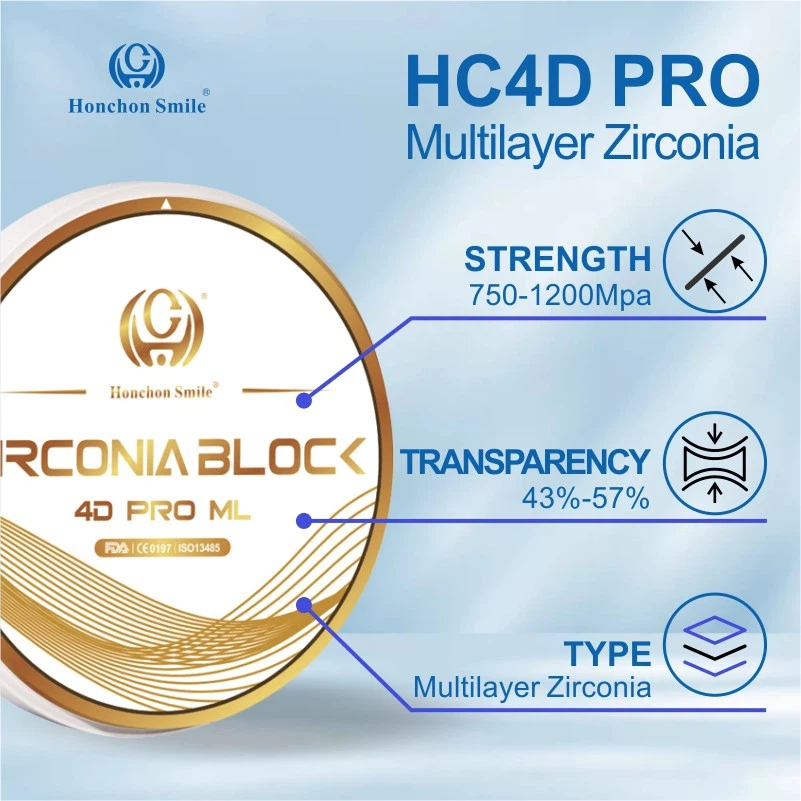
This outstanding lifespan performance is rooted in the unparalleled physical properties of the material. The flexural strength of sintered zirconia restorations usually exceeds 1200 megapascals, and the Vickers hardness is as high as 1250 HV. This value is three times that of traditional cobalt-chromium alloys and is sufficient to withstand a bite force of up to 800 Newtons, which is equivalent to 5 to 8 times the normal bite force of an adult's front teeth. An eight-year follow-up study released by the Dental Center of the University of Zurich in 2022 confirmed that in cases using zirconia single crowns, the failure rate due to material fracture was only 0.3%, far lower than the approximately 5% failure rate of resin-based materials.
 The longevity of zirconia restorations is also attributed to their outstanding biological stability and anti-aging performance. In the accelerated aging experiment simulating an oral environment (with temperature cycling between 5 and 55 degrees Celsius and 100% humidity), the strength attenuation rate of zirconia material was less than 5% after more than one million cycles of load. In contrast, the strength of some old-fashioned ceramic materials may drop by more than 20% under the same rigorous tests. This stability ensures that the restoration can maintain its morphological integrity for a long time in the complex chemical and temperature environment of the oral cavity, effectively preventing the growth and expansion of microcracks.
From the perspective of long-term economic benefits, the advantages of zirconia restorations are more prominent. Although its initial cost may be about 15% higher than that of a metal-ceramic crown, considering its extremely low risk of restoration fracture and the associated secondary treatment costs, the patient's long-term total expenditure is actually significantly reduced. A cost-benefit model based on data from dental insurance in the United States indicates that choosing zirconia restorations can save patients an average of 30% in potential medical costs over a 15-year period. Therefore, investing in a restoration made from high-quality zirconia blocks is not only a long-term guarantee for the patient's oral health, but also a wise financial decision with a high return rate. Its service life has the potential to exceed 20 years or even longer.
The longevity of zirconia restorations is also attributed to their outstanding biological stability and anti-aging performance. In the accelerated aging experiment simulating an oral environment (with temperature cycling between 5 and 55 degrees Celsius and 100% humidity), the strength attenuation rate of zirconia material was less than 5% after more than one million cycles of load. In contrast, the strength of some old-fashioned ceramic materials may drop by more than 20% under the same rigorous tests. This stability ensures that the restoration can maintain its morphological integrity for a long time in the complex chemical and temperature environment of the oral cavity, effectively preventing the growth and expansion of microcracks.
From the perspective of long-term economic benefits, the advantages of zirconia restorations are more prominent. Although its initial cost may be about 15% higher than that of a metal-ceramic crown, considering its extremely low risk of restoration fracture and the associated secondary treatment costs, the patient's long-term total expenditure is actually significantly reduced. A cost-benefit model based on data from dental insurance in the United States indicates that choosing zirconia restorations can save patients an average of 30% in potential medical costs over a 15-year period. Therefore, investing in a restoration made from high-quality zirconia blocks is not only a long-term guarantee for the patient's oral health, but also a wise financial decision with a high return rate. Its service life has the potential to exceed 20 years or even longer.
The longevity of zirconia restorations is also attributed to their outstanding biological stability and anti-aging performance. In the accelerated aging experiment simulating an oral environment (with temperature cycling between 5 and 55 degrees Celsius and 100% humidity), the strength attenuation rate of zirconia material was less than 5% after more than one million cycles of load. In contrast, the strength of some old-fashioned ceramic materials may drop by more than 20% under the same rigorous tests. This stability ensures that the restoration can maintain its morphological integrity for a long time in the complex chemical and temperature environment of the oral cavity, effectively preventing the growth and expansion of microcracks.
From the perspective of long-term economic benefits, the advantages of zirconia restorations are more prominent. Although its initial cost may be about 15% higher than that of a metal-ceramic crown, considering its extremely low risk of restoration fracture and the associated secondary treatment costs, the patient's long-term total expenditure is actually significantly reduced. A cost-benefit model based on data from dental insurance in the United States indicates that choosing zirconia restorations can save patients an average of 30% in potential medical costs over a 15-year period. Therefore, investing in a restoration made from high-quality zirconia blocks is not only a long-term guarantee for the patient's oral health, but also a wise financial decision with a high return rate. Its service life has the potential to exceed 20 years or even longer.
●●●
Spotted a junction that deserves a warning?
Help us keep Britain's drivers informed. Submit a BlackSpot report in under two minutes.