
What Drives the Unit Cost of Perfume: A Checklist for an Influencer Launch
Unit cost is decided by five things long before a factory quotes a price: the concentrate, the bottle and box, filling and labour, compliance and testing, and order size. Most arguments between a brand and a factory are actually arguments about one of those five, mislabelled as 'the price'. An influencer founder who separates them before asking for a quote gets a number that is comparable to other quotes, and a product whose cost matches the story they want to sell.
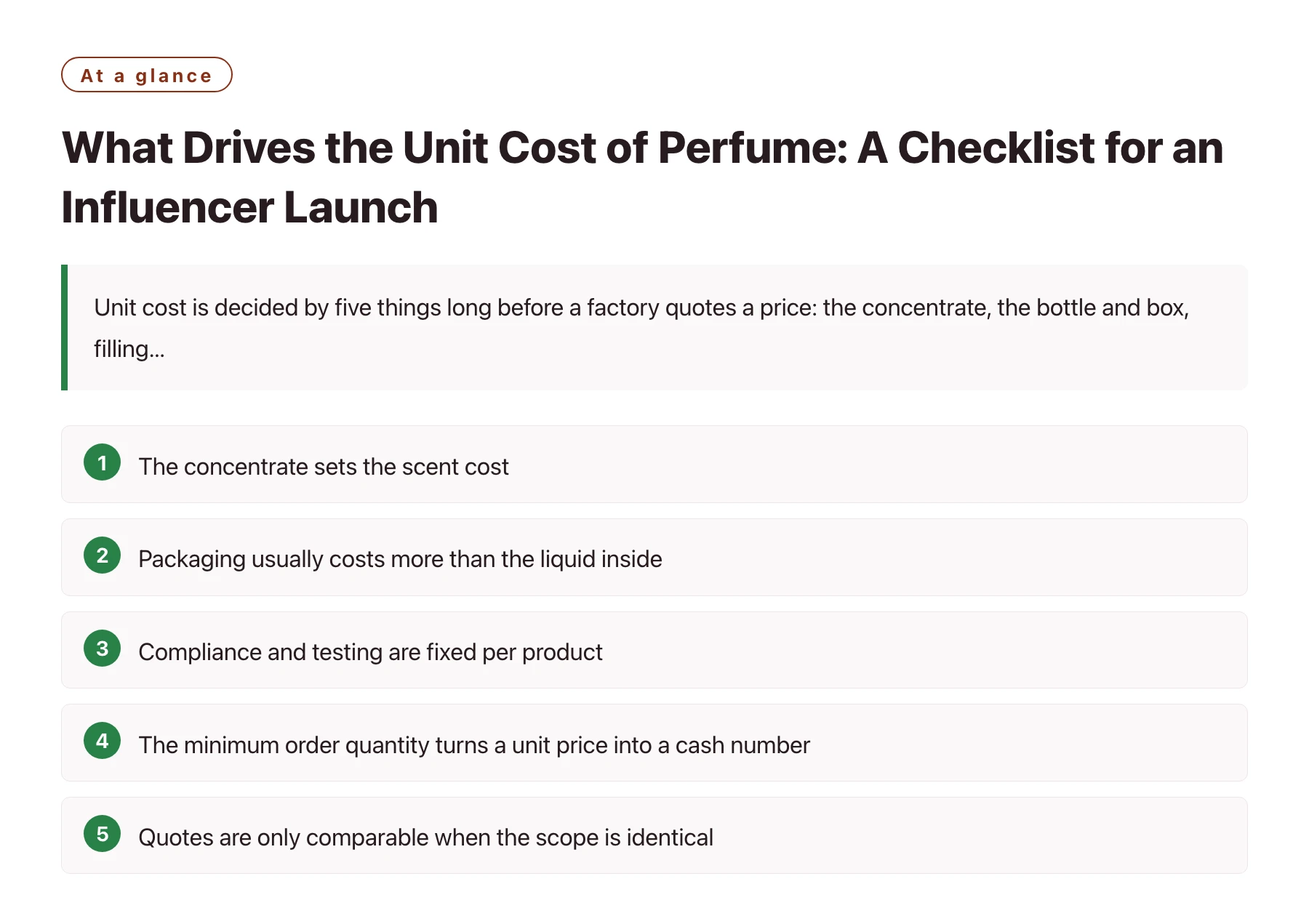
Key takeaways
- The concentrate sets the scent cost, and the percentage of concentrate in the bottle is the most reused lever in a quote.
- Packaging usually costs more than the liquid inside, which is where a premium feel is actually bought.
- Compliance and testing are fixed per product, so they weigh heaviest on a small first order.
- The minimum order quantity turns a unit price into a cash number, and cash is what usually breaks an influencer budget.
- Quotes are only comparable when the scope is identical, so the first checklist item is a written definition of what is made in house.
The most common way to price a perfume project is backwards. A founder asks for a unit price, gets a number, and only later discovers that the number assumed nothing about concentration, packaging or testing — or assumed a very different version of each.
For an influencer launching their own line, the stakes are a little different from a classic brand launch. The audience already exists, the launch date is usually tied to content, and the cash is often personal. That makes unit cost the single most important number in the project, because it sets the retail price, the margin and the minimum order all at once.
This article walks through the five drivers one at a time, and ends with the checklist worth running before you ask any factory for a quote.
The five drivers behind every quote
The concentrate comes first. Two ingredients decide most of its cost: how much perfume oil sits in the finished product, and which raw materials that oil is built from. A higher oil percentage costs more per bottle, and so does a formula built around rare naturals rather than synthetics. Both are legitimate choices; they just need to be named, because 'the scent' is not a cost category, it is a specification. One practical detail: a formula that works inside the IFRA restrictions is more expensive to build than one that ignores them, because the compliant substitute for a restricted material is often costlier than the restricted original [1].
Second is packaging. The bottle, cap, collar, carton and labels routinely cost more than the liquid they contain, and every decorative element — a second colour, a heavier cap, a foil stamp — multiplies through tooling and assembly time. This is also the category where a premium impression is actually purchased, which is why a smart buyer spends the packaging budget deliberately rather than accidentally.
Third is filling and labour. Every bottle has to be filled, closed, checked, labelled and boxed by hand or by line, and the per-unit cost of that work is fairly flat across factories. What changes it is decoration: crimping a metal collar, attaching a cord or inserting a dip tube changes the seconds per bottle, and seconds become money.
Fourth is compliance and testing. Fragrance ingredients are restricted in many markets, finished products need stability and microbiological testing, and a product destined for the EU needs its safety documentation and notification in place before it can be sold at all — none of which scales with volume [2].
Fifth is order size. The unit price is almost meaningless without a quantity, because every line — raw materials, testing, tooling amortisation and setup — divides differently across 300, 3,000 or 30,000 units. A factory that will not state a unit price per quantity band is either not yet sure of its own numbers, or expecting you not to compare them.
How each driver moves the number
| Cost driver | What changes it | Where buyers get misled |
|---|---|---|
| Concentrate | Oil percentage and raw material choice | Thinking the scent is one price instead of a specification |
| Packaging | Bottle, cap, decoration, carton and their tooling | Assuming the bottle is a small part of the cost |
| Filling and labour | Decoration complexity and line speed | Comparing quotes that cover different scopes |
| Compliance and testing | Destination market and test programme | Discovering testing was never inside the price |
| Order size | Quantity bands and amortised tooling | Multiplying a unit price by units without checking the minimum |
Read the middle column first. Every row is a decision you make, not a number the factory invented — which is why the same brief can be quoted far apart by two honest factories.
Turning the drivers into a checklist
Run the checklist before you ask for a quote, and send the same brief to every shortlisted factory. First, fix the scent brief: oil percentage, the rough raw material budget, and whether the formula can be shared or must stay exclusive. Second, cap the packaging: decide the maximum tooling spend before you fall in love with a bottle on social media.
Third, ask for testing as a line item. Once the quote arrives, the skill of reading a perfume price breakdown tells you which driver each line belongs to, so the comparison stays honest reading a perfume price breakdown.
Fourth, check the scope, not just the number. A factory that compounds, fills and decorates under one roof — fragrance manufacturing under one roof — has fewer paid hand-offs than one that subcontracts half the steps, which changes both price and lead time fragrance manufacturing under one roof.
Finally, do the homework any serious buyer does before the first email: the fragrance manufacturer's website should already show service scope, certifications and contact routes before you ask the fragrance manufacturer's website. Microbiological and stability testing by an independent laboratory is a normal line in a professional quote, and a supplier who will not split it out is a supplier who is not finished quoting [3].
If a checklist feels mechanical, keep one question in mind: 'which line of the quote would this decision move?' Price negotiations that stay on 'the price' go in circles; negotiations that move one driver at a time end in a signature.
Sources
- IFRA Standards Library (International Fragrance Association) —— The IFRA Standards Library lists the restrictions the fragrance industry applies to individual fragrance ingredients, based on safety assessments; it is the reference point for compliant fragrance formulation.
- European Commission: Cosmetics in the EU —— The European Commission's overview of EU cosmetics rules, including the responsible person, product information file and safety report requirements.
- SGS: Cosmetics, Personal Care & Household Testing —— Testing, inspection and certification services for cosmetics and personal care, including microbiological, stability and safety testing aligned with cosmetics GMP.
Frequently asked questions
Why do two factories quote very different prices for the same perfume?
Almost always because the scope is different, not the quality: oil percentage, packaging specification, testing included, tooling amortised and minimum order size can all differ silently. Compare line by line, not number to number.
Is the concentrate or the bottle the bigger part of the unit cost?
For most fragrances sold in a branded bottle, packaging costs more than the liquid. The concentrate is usually the smaller line unless the formula uses expensive naturals at a high percentage, which is why a brief must fix both before pricing.
How much do compliance and testing add to a small perfume run?
Stability and microbiological testing are quoted as fixed programmes, so as a share of unit cost they are largest on the smallest order. On a first run of a few thousand units, treat testing as a several-percent line item, then watch it shrink as volume grows.
What is a realistic minimum order for a first perfume batch?
It depends on the factory and the packaging, which is exactly why the number should be written down before design work starts. As a budget habit, multiply the minimum by the unit price and check the result against your cash, because that product is your exposure.
Can an influencer bring the unit cost down after the first batch?
Yes, and the levers are the same five drivers: raise volume, simplify decoration, hold the oil percentage steady, reuse the bottle across the line, and keep the same test programme so quality does not silently drop while the price does.
Spotted a junction that deserves a warning?
Help us keep Britain's drivers informed. Submit a BlackSpot report in under two minutes.