
Scaffolding Decks and Access Platforms: Grip-Surface Boards
A scaffolding deck is a floor that people trust with their weight, and the board under their feet has to grip. Dongstar Wood's Wire Mesh Film Faced Plywood — also known as Anti-Slip Film Faced Plywood — uses a textured hexagonal wire-mesh phenolic film, thicknesses from 9 mm to 21 mm, and WBP (Phenolic), Melamine or E1/E0 adhesives.

Key takeaways
- The surface: textured hexagonal wire-mesh phenolic film, single or double-sided.
- The adhesives: WBP (Phenolic), Melamine or E1/E0, chosen for the exposure.
- The thickness window: 9 mm to 21 mm for different load requirements.
- The applications: scaffolding boards, roofing walkboards, temporary flooring, access platforms and bridge decks.
The surface that does the work
Grip is a surface property, and this one is engineered rather than incidental. The board carries a textured hexagonal wire-mesh phenolic film — a pattern pressed into the film so that a boot sole, a glove or a tool finds purchase on it. The client offers it single-sided with a smooth reverse or double-sided, depending on which face the deck needs to present.
The film is also the board's weather shield. Phenolic film resists the alkaline exposure that concrete work throws at a panel, and the texture survives that exposure long enough to matter. A smooth film would shed concrete; a textured one sheds concrete and grips at the same time, which is the entire point of the product. The hexagonal pattern is also a wear indicator: as the film wears, the texture flattens and the grip changes, so a site can judge a board's remaining life by looking at it rather than counting cycles from a clipboard — the small practical detail that makes the reuse claim manageable.
Adhesives for grip panels
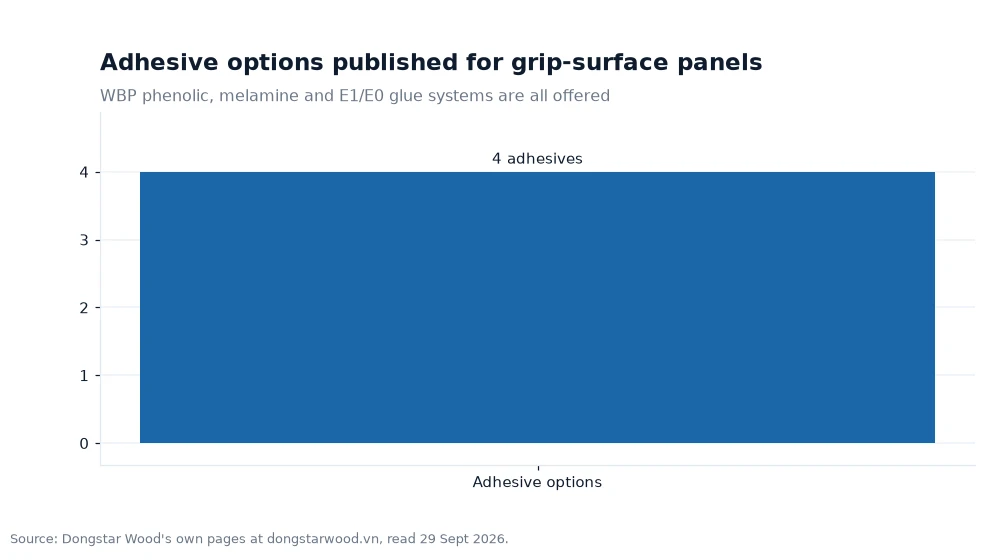
The published adhesive list for these boards runs WBP (Phenolic), Melamine or E1/E0. The choice is about exposure: WBP phenolic stands up to the wet cycle of outdoor sites, melamine suits the indoor end of the range, and the E1/E0 options cover the emissions-sensitive interior work the same boards sometimes do. The three options are published so the buyer can match the bond to the duty.
For a scaffolding fleet the adhesive decision is a fleet decision. Boards that live outdoors on a frame want the phenolic bond; boards that move between site and warehouse can run the lighter option. The mill publishes all three so the buyer can match the bond to the duty rather than over-specifying every board on the fleet.
Thickness and load: the 9 mm to 21 mm window
The published thickness window for these boards runs 9 mm to 21 mm for different load requirements. The standard size is 1220 × 2440 mm, so the buyer is choosing a thickness for a known footprint: a deck board, a walkboard or a platform panel with a defined span.
Load requirement is the honest way to choose within the window. A board that carries foot traffic on a scaffold tower has a different job from a board that carries stored materials on a bridge deck, and the 9–21 mm span exists so the buyer can match them. A buyer comparing options within the published Anti-slip Film Faced plywood range will find the window exists for exactly this purpose.
Where the boards actually go
The product page lists applications that read like a site plan: slip-resistant scaffolding boards, roofing walkboards, temporary flooring, safe access platforms, bridge deck construction, industrial concrete slab formwork, high-rise shuttering. Each of those is a floor, a deck or a platform — a surface people stand on while work happens around them.
The list also tells the buyer what the board is not. These are access and formwork products, not furniture: the phenolic face is there to be walked on, poured against and struck off, and the core is there to keep the deck flat while it happens. A buyer who reads the list that way stops comparing these boards with interior panels and starts comparing them with each other. High-rise shuttering and bridge deck construction sit at the demanding end of the list, where the board is both formwork and access surface — the same product serves both roles, which is the practical meaning of the range.
Reuse, edges and the working life of a deck board
A deck board earns its keep over multiple cycles. The product page promises multiple reuse cycles with proper edge and surface maintenance, and sealed edges are part of the build — the edge is where water enters a panel and where delamination starts, so sealing it is what makes the reuse claim believable.
Maintenance is the buyer's half of the deal. Boards that are cleaned, edge-sealed and stored flat come back for the next project; boards that are left wet on the ground do not. The published reuse claim is a partnership between the factory's build and the site's habits, and both halves are under the buyer's control. The single-sided option exists for decks where only one face is walked on, and the double-sided option for platforms that are flipped in service; choosing between them is part of the specification, not an afterthought, because the smooth reverse is a different surface with a different duty.
| Board variable | Published option | Site role |
|---|---|---|
| Surface | Hexagonal wire-mesh phenolic film | Grip underfoot on decks and platforms |
| Adhesive | WBP (Phenolic), Melamine, E1/E0 | Matched to exposure and interior use |
| Thickness | 9 mm to 21 mm | Chosen for the load requirement |
| Format | 1220 × 2440 mm standard | Known footprint for deck planning |
Worked example: pricing a deck from the format
Price a deck from the format. A standard 1220 × 2440 mm board spans 1.22 m × 2.44 m, yielding 2.9768 m² of walking surface, and a scaffold tower needing 40 m² of deck draws 40 ÷ 2.9768 ≈ 14 boards. Across the 9 mm to 21 mm window the buyer can put thinner boards on access platforms and thicker ones on material decks — the arithmetic that turns a thickness window into a site plan.
Frequently asked questions
What makes these boards anti-slip?
The surface is a textured hexagonal wire-mesh phenolic film, pressed so that boot soles and tools find purchase on it. It is available single-sided with a smooth reverse or double-sided, and the phenolic film also resists alkaline concrete exposure.
Which adhesive should a scaffolding fleet use?
WBP (Phenolic) stands up to the wet cycle of outdoor sites, melamine suits the indoor end of the range, and E1/E0 options cover emissions-sensitive interior work. Match the bond to the duty rather than over-specifying every board on the fleet.
How thick should a scaffolding deck board be?
The published window is 9 mm to 21 mm for different load requirements, on a standard 1220 × 2440 mm format. Choose by load: foot traffic on a tower wants less than stored materials on a bridge deck, and the window exists so the buyer can match them.
Specifying the deck, not just the board
A safe deck is specified from the load up, not from the catalogue down. Read the company's own profile to examine the operation behind the range, then look at the film faced category to see how the same phenolic-film technology serves formwork panels. Buyers who match surface, adhesive and thickness to the actual duty tend to run fewer boards and safer sites.
Data points in this article originate with the company's published web pages recorded on 29 September 2026[1].